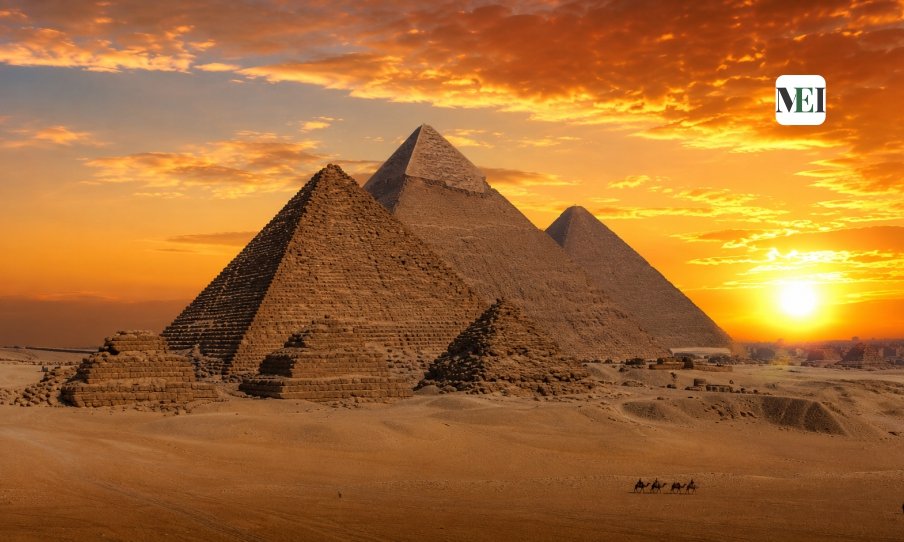
There is hardly any other place on Earth where the force of human curiosity had been trying to reveal the truth about thousands of years-old mysteries than the desert sands of Egypt. This unique landscape, which has been raised on the backs of ancient obelisks, has attracted the attention of innumerable scientists, historians, and ordinary travelers for centuries. Countless riddles surround the constructions made by Egypt’s ancestors, among which the most prominent are the Pyramids of Giza. Their ancient beauty and mysterious formation principles still puzzle researchers, who cannot understand how such structures could be built several millennia ago on the territory of historic Egypt.
The Monuments of the Old Kingdom
In order to grasp the true scale of the pyramids, one should first study their architectural standards and construction techniques. The complex consists of three large Egyptian pyramids, which were built as tombs for three different pharaohs during the Fourth Dynasty. The largest and most famous monument of the complex, which is called the Great Pyramid, was constructed for Pharaoh Khufu. It was the tallest building in the world for three and a half millennia. When standing in front of such a giant construction, one will certainly be amazed by the precision of blocks’ placement and their enormous weight. Blocks made of limestone had to be dragged from quarries many kilometers away by hundreds of workers. This process took a considerable amount of time and effort.
Despite the simplicity of the construction techniques used by the ancient builders, the pyramids possess one very intriguing feature – their perfect alignment with the cardinal directions. Experts have long debated on how exactly the ancients managed to achieve such an accurate location of the monuments, which speaks highly of their astronomical knowledge. Researchers claim that there is no trace of slavery in the construction of these majestic buildings. It is believed that the workers were well-fed and motivated soldiers, farmers, and artisans who built the pyramids for the love of Egypt and its gods.
Spiritual Pathways to the Afterlife
For the ancient Egyptians, life on Earth was merely a temporary prelude to the eternal existence that awaited them after death. The pharaoh was viewed as a living god, a bridge between the mortal realm and the divine universe. Therefore, ensuring the pharaoh’s safe transition to the afterlife was vital for the cosmic order and prosperity of the entire nation. The pyramids of giza were not just simple graves; they were highly sophisticated spiritual machines designed to launch the pharaoh’s soul into the heavens to join the sun god, Ra, and the ruler of the underworld, Osiris.
Inside these giant stone structures, a complex network of corridors, grand galleries, and burial chambers was carved out of the solid rock. The walls of these chambers were often left unadorned in this specific era, relying instead on the purity of the geometric design and the protective power of the massive stone blocks. To protect the king’s mummy and his vast treasures for eternity, the architects designed ingenious security systems, including massive granite portcullis blocks meant to seal off the inner sanctuaries from tomb robbers. Despite these efforts, the treasures of the pyramids of giza were plundered in antiquity, leaving behind only empty stone sarcophagi and tantalizing clues for modern archaeologists to decipher.
Echoes of Ancient Wisdom in Modern Times
The endurance of these monuments across thousands of years speaks directly to the advanced scientific understanding of the ancient Egyptians. They possessed a deep knowledge of mathematics, geometry, and geology that allowed them to build structures capable of withstanding earthquakes, intense desert heat, and the relentless passage of time. When we study the pyramids of giza today, we are looking at a masterclass in structural engineering. The weight distribution of the massive stone layers was calculated so perfectly that the foundations have barely shifted over nearly five millennia, an achievement that modern builders still look upon with profound respect.
Beyond their physical endurance, these monuments hold a unique cultural power that transcends borders and generations. They serve as a global symbol of human potential, proving that humanity has always possessed the drive to reach for the extraordinary. Visiting the pyramids of giza allows us to connect with our collective past, reminding us of a time when humans looked at the sky and sought to mirror the eternal order of the stars in the bedrock of the Earth. This cross-generational fascination ensures that the site remains one of the most studied and visited locations on our planet.
Preserving the Wonders for the Future
As we navigate the complexities of the modern era, preserving these fragile ancient treasures has become a critical global mission. Environmental factors such as rising ground water, shifting desert winds, and urban encroachment from the nearby city of Cairo present constant challenges to the structural integrity of the complex. The pyramids of giza require continuous monitoring and delicate restoration work to ensure that future generations can experience their silent majesty. Modern scientists are now using non-invasive technologies, such as cosmic-ray muon radiography and thermal imaging, to peer inside the stones without disturbing the ancient structures, revealing hidden voids and undiscovered chambers.
In conclusion, the plateau remains a place of profound wonder and endless discovery. The pyramids of giza are far more than just tourist destinations or historical footnotes; they are living monuments to human ingenuity and spiritual devotion. As modern technology advances, we may finally uncover the remaining secrets locked within their massive stone walls. Until then, the pyramids of giza stand quietly on the edge of the desert, watching the rise and fall of modern empires just as they watched the passing of the ancient world, inviting us all to dream, explore, and marvel at what humanity can achieve.