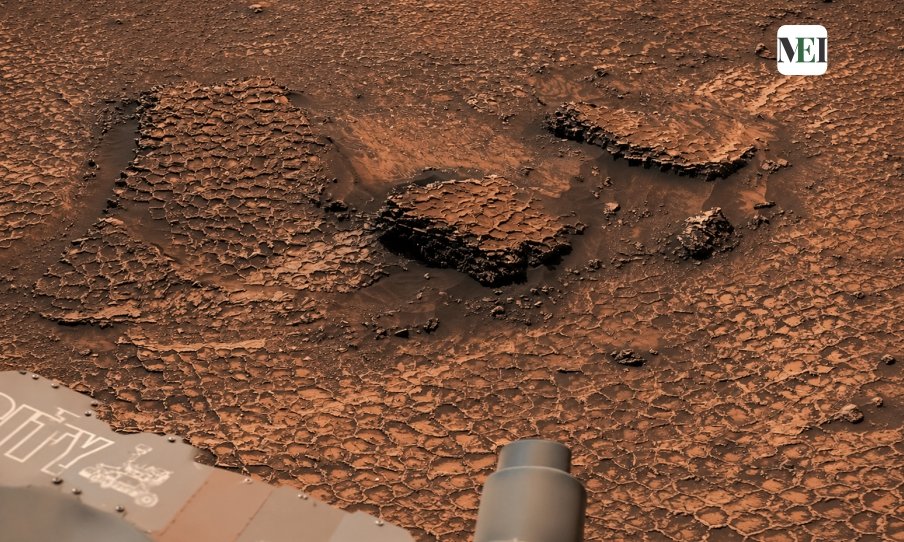
Mars has a long history of fascinating researchers, but the latest discovery seems to be the most intriguing one yet. New photos from NASA’s mars rover uncovered a mystery that has geologists speculating. An area of the planet covered in an abundant amount of honeycomb-shaped patterns is proving to be an amazing find. The area, which looked like an ordinary rocky plain from a distance, became a sight to behold when viewed up close, sparking questions about how exactly it was formed.
This discovery is not only a good thing because it is yet another beautiful photo to add to the long list of amazing images taken on Mars. It may help scientists determine the past climate of Mars, how much water it used to have, and whether or not it could have possibly supported different types of microbial life. Every rock formation uncovered adds another piece to the intriguing puzzle that is Mars’ past.
Honeycombs Take Over the Landscape
The latest photos from Mars showcase a large series of polygon-shaped ridges that span on and on like a giant honeycomb covering the landscape. In the past, scientists have found smaller polygon-shaped fractures on Mars, but they were still surprised to see such a massive patterned area.
The pictures were taken in a valley called Valle Grande, and the pattern stretches on for quite some distance in the direction the rover was facing. Members of the research team were amazed to say the least, commenting on how they felt like they were seeing a “sea of polygons,” and that it was definitely something out of the ordinary for them.
The nasa mars rover has spent years climbing the lower slopes of Mount Sharp, documenting sedimentary rocks, ancient riverbeds, and mineral deposits. This remarkable discovery now adds another fascinating chapter to its scientific journey.
What Could Have Created These Polygon Patterns?
The biggest mystery surrounding these formations is their origin. Scientists have proposed several possible explanations, but none has yet been confirmed.
One leading theory suggests the polygons formed when ancient mud repeatedly dried and cracked over millions of years. Similar patterns can be found on Earth in dried lake beds, where cycles of wetting and drying leave behind polygon-shaped fractures. If that explanation holds true, the formations would strengthen evidence that liquid water once existed in this part of Mars.
Another possibility involves temperature changes. Extreme heating during the day and freezing conditions at night may have gradually fractured the rocks into geometric shapes over immense periods of time. Researchers are also considering whether groundwater movement, sediment compression, or mineral-filled cracks played a role in creating the distinctive texture.
The nasa mars rover will continue studying the surrounding rocks and collecting detailed observations to determine which theory best matches the geological evidence.
Why This Discovery Matters
At first glance, these honeycomb patterns may simply appear visually impressive. However, their scientific importance extends much deeper.
Understanding how these formations developed helps researchers reconstruct Mars’ environmental history. If they were created by drying sediments, it would provide further support for the idea that lakes, rivers, or shallow water bodies once existed in the region billions of years ago.
Scientists have long believed that Gale Crater, where the rover operates, once contained a massive lake system. Each new geological feature offers additional pieces of that puzzle, helping determine how long water remained on the planet and whether conditions were stable enough for microscopic life to emerge.
Geological formations also preserve records of climate changes. By analyzing the chemistry of rocks surrounding these polygons, researchers may discover whether Mars experienced repeated wet and dry cycles or whether entirely different geological forces shaped the terrain.
The Journey of Exploration Continues
Since landing in 2012, Curiosity has transformed humanity’s understanding of Mars. It has discovered evidence of ancient freshwater lakes, organic molecules, sulfur-rich minerals, and numerous sedimentary formations that suggest the Red Planet was once far more hospitable than it appears today.
This latest discovery demonstrates that Mars still holds countless unanswered questions. Every kilometer traveled introduces new landscapes that challenge existing theories and inspire fresh scientific investigations.
The nasa mars rover remains one of humanity’s most productive explorers, proving that even after more than a decade on another world, it continues to uncover surprises capable of reshaping our understanding of planetary history. Whether these remarkable honeycomb formations are remnants of ancient lakes, evidence of groundwater activity, or the result of entirely different geological processes, future analysis will undoubtedly reveal more about the planet’s complex evolution.
For now, the breathtaking “sea of polygons” serves as another reminder that Mars is far from a lifeless, unchanging desert. Beneath its dusty surface lies a rich geological archive waiting to be decoded, one discovery at a time.