AI coding assistants can produce application code in minutes, helping development teams build features, connect services, and automate routine tasks with less manual effort. Yet code that runs correctly is not necessarily code that can withstand an attack. A generated login function might accept valid credentials, for example, while failing to limit repeated attempts. A database query may return the expected information but expose the application to SQL injection because user input has not been handled safely.
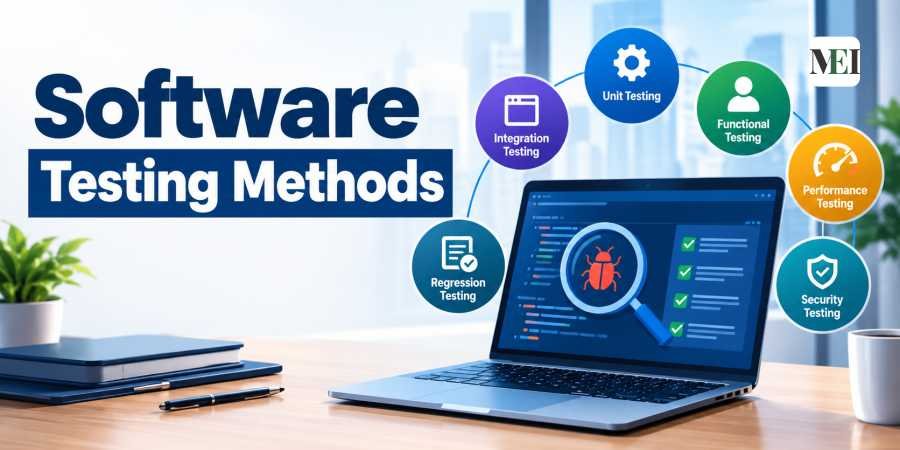
This gap between functionality and security makes Software Testing Methods especially important as businesses adopt AI-assisted development. Generated code can contain familiar programming errors, overlooked access controls, unsafe dependencies, and weaknesses that become visible only when several components interact. The challenge is not to reject AI-generated code, but to verify its behaviour before it reaches production.
Research published in Veracode’s 2026 GenAI Code Security Report found that approximately 44% of the AI code-generation tasks it tested produced code containing a known security vulnerability. The assessment covered more than 100 large language models and several widely used programming languages.
Although benchmark results do not predict the security of every application, they demonstrate why developers cannot treat generated code as trustworthy simply because it compiles or passes routine functional tests.
Start With Static Analysis and Secure Code Reviews
Static application security testing, commonly known as SAST, examines source code without requiring the application to run. It can identify patterns associated with SQL injection, cross-site scripting, unsafe cryptographic choices, and other recognised weaknesses. Running these checks as AI-generated code enters a project gives developers an opportunity to investigate problems before they become embedded in larger features.
Software Testing Methods based on static analysis are particularly useful when development teams generate code rapidly across multiple files or services. A developer might ask an AI assistant to create a customer registration endpoint. The resulting function could appear complete while storing passwords insecurely or trusting information supplied by the browser. Static analysis can flag suspicious implementations, while a security-focused code review determines whether the issue is exploitable in the application’s actual context.
Automated tools still have limitations. They may report harmless code patterns as potential vulnerabilities or miss weaknesses that depend on runtime conditions. Teams should therefore combine scanning with manual review, paying particular attention to authentication, authorisation, data handling, and cryptographic operations. The objective is not simply to produce a clean report, but to understand whether the code protects the information and actions it controls.
Test the Running Application, Not Just the Code
Some vulnerabilities become apparent only when an application interacts with a database, an external service, or a real user session. Dynamic application security testing (DAST) examines a running application by sending requests and observing its responses. It can expose problems such as insecure session handling, unexpected information disclosure, and endpoints that respond incorrectly to unauthorised requests.
These Software Testing Methods complement static analysis because they examine a different part of the security picture. Consider an AI-generated customer portal with separate accounts for customers and administrators. The code may appear to check whether a user is logged in, but a tester might discover that changing an account identifier in a request allows one customer to view another customer’s records. This is an authorisation failure that ordinary functional testing may overlook.
Penetration testing adds a more adversarial perspective. Security specialists attempt to exploit the application using realistic attack scenarios, examining how individual weaknesses might combine to produce a larger compromise. For AI-generated applications, this is particularly valuable when unfamiliar code has been assembled quickly or when several AI-produced components communicate with one another.
Testing should take place in controlled environments using authorised accounts and synthetic data wherever possible. Fixes must then be retested to confirm that the vulnerability has been resolved without breaking legitimate functionality.
Examine Dependencies and the Software Supply Chain
AI assistants frequently recommend external libraries, frameworks, and code examples to complete a task. A generated application may therefore inherit risks from a vulnerable package, an outdated component, or a dependency that does not come from a trustworthy source. Even well-written application code can be compromised by weaknesses elsewhere in its software supply chain.
Software Testing Methods should include software composition analysis, which identifies third-party components and checks them against known vulnerability databases. Teams should also review dependency versions, package sources, licensing requirements, and whether a library is still maintained. Generating a dependency list or software bill of materials can improve visibility into the components that make up an application.
The OWASP Top 10 for Large Language Model Applications, including its 2025 edition, identifies supply-chain weaknesses and insecure output handling among the risks associated with AI-enabled systems.
These concerns extend beyond conventional application code. An AI assistant may recommend a package that does not exist, suggest an unsafe configuration, or produce an integration that gives an external component more access than it needs.
Automated dependency checks are useful, but developers should verify that recommended packages are legitimate and appropriate for the intended task. Keeping dependencies current, limiting application permissions, and removing unnecessary components reduce the number of opportunities an attacker might exploit.
Test AI-Specific Behaviour and Unusual Inputs
Applications that incorporate AI models require additional testing because their behaviour can depend on prompts, retrieved documents, model responses, and access to external tools. Traditional security tests remain essential, but they may not cover attacks that manipulate the model itself.
For example, an AI-powered support assistant might retrieve customer account information and use a connected service to process requests. A malicious message embedded in a document could attempt to override the assistant’s intended instructions or persuade it to disclose confidential information. Testers should examine whether untrusted content can influence the system’s decisions, bypass permission checks, or trigger actions that the user is not authorised to perform.
Software Testing Methods for these applications should include adversarial testing, prompt-injection scenarios, data-leakage checks, and verification of tool permissions. Testers should also examine whether the application treats model-generated output as trusted input. If an AI model produces a database query, a file path, or an instruction for another service, the application must validate it before execution.
The OWASP guidance on large language model applications highlights prompt injection, sensitive information disclosure, excessive agency, and unbounded consumption as important risk areas.
These risks make it essential to test not only individual responses but also the actions an application takes as a result of those responses.
Measure Security Beyond a Passing Test
Passing a collection of security tests does not guarantee that an application is completely safe. Testing tools have blind spots, attack techniques evolve, and a change made to fix one problem can introduce another. Organisations should therefore evaluate the quality of their testing process as well as its results.
Software Testing Methods should be reviewed whenever the application architecture, AI model, dependencies, or access permissions change significantly. Human security expertise remains necessary for interpreting complex findings and challenging assumptions that automated tools cannot reliably assess. Developers also need clear guidance on how to use AI assistants responsibly, including restrictions on sharing confidential source code or credentials with unapproved services.
Finally, reliable Software Testing Methods turn security from a final checkpoint into a continuous engineering responsibility. AI can help teams write code faster, but the responsibility for verifying that code remains with the people and organisations deploying it. That distinction is what allows innovation to move forward without making hidden vulnerabilities an accepted cost of progress.