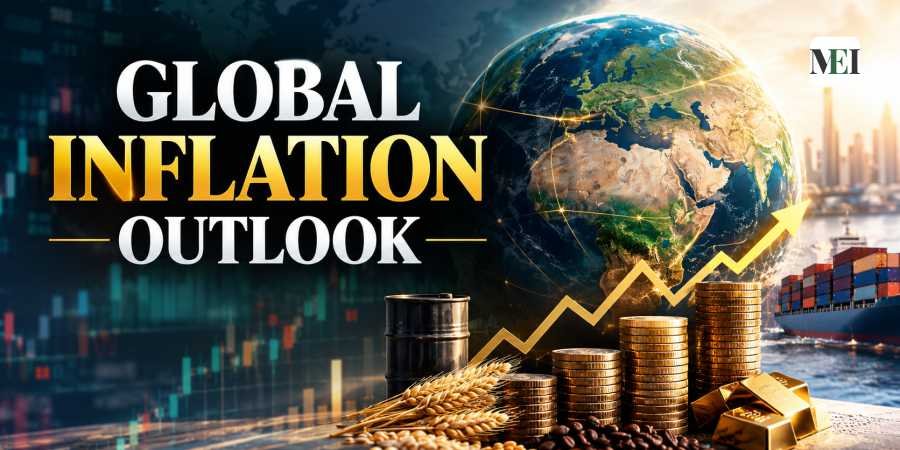
The Global Inflation Outlook Reveals How Household Budgets, Business Decisions, and Government Policies Will Shape the Next Phase of Economic Stability
Inflation affects decision-making. A household will defer the purchase of a car; a restaurant owner will think twice about the pricing on their menus; and a manufacturer will delay an expansion of production because the cost of running the business has become uncertain. While these decisions might seem unrelated to each other, collectively they affect demand for goods and services, job creation, investments, and economic growth.
The Global Inflation Outlook, therefore, is not merely about price changes in the consumer price index. This is about the forces affecting purchasing power, corporate cost management, and government efforts to achieve economic stability. With 2026 approaching and then 2027, the key question to be answered is whether price pressures will subside enough to allow for financial confidence.
Why Falling Inflation Does Not Mean Cheaper Living
One of the common misconceptions about the inflation is the confusion between a reduction in the rate of price increase and decreasing prices. With declining inflation, the prices of products and services will still be rising, just at a reduced pace. This means that a family, having faced a series of years with rising prices for food, housing, and transportation, will not necessarily feel any change immediately.
This situation occurs since salaries and savings of households do not necessarily follow the changes in the price level of goods and services. Employees who cannot keep up with the rising prices will cut their expenditures, and low-saving families will not be able to accommodate any additional unexpected expenses.
The global inflation outlook will thus need to be considered taking into account not only the current levels of inflation but also the financial pressure that households face.
The Supply Side Can Change the Entire Forecast
Inflation results from a variety of sources. Consumer demand drives inflation upwards, but disruptions in the areas of production, transportation, energy resources, and agriculture can all cause cost increases. All of these variables tend to have different impacts on particular industries, making the entire process difficult to forecast.
The area of energy is an example. An increase in fuel prices can drive up the cost of transportation, impact the budget of the manufacturer, and determine the prices for energy intensive goods.
Prices for food products might fluctuate depending on the weather conditions, crop yields, capacity for storage, and the cost of transportation. Firms would need to decide on the share of the new cost that they can absorb and the share that needs to be passed on to consumers.
The Global Inflation Outlook will have to factor in the sustainability of these effects. A short-term shock could result in only a limited price adjustment. But repeated shocks could impact wages negotiations, pricing, and expectations about future costs.
Interest Rates Create Difficult Choices
In order to balance risks of persistent inflation and reduced economic activity, central banks need to consider the danger that higher interest rates will slow down borrowing and hence demand, but at the same time increase the cost of financing for the private sector. Lower interest rates, on the other hand, will stimulate investment and consumption but might lead to more rapid growth of prices.
This problem gets even more difficult if inflation is caused not by excess of demand but by some supply bottlenecks. Monetary policy cannot produce more crops, open the trade route or build additional electricity network, but it can affect the environment in which the spending takes place and help avoid the contagion effect.
Thus, for the Global Inflation Outlook, the trend of the interest rate will depend on the nature of the inflation in each country. The focus should be placed on wages, services, credit, and expectations.
Businesses Need a Different Approach to Cost Management
Not all external price shocks can be avoided by businesses; however, they can enhance their capabilities in dealing with them. Organizations that know about their cost structure will be able to spot areas of risk of losing profits, over-reliance on suppliers who are responsible for this risk, and inefficiencies within the company.
Procurement staff can find alternative suppliers, financial departments can stress-test budgeting for different cost structures, while operations managers can review energy usage, inventory and production processes. While none of these actions provides immunity against inflation, they can minimize the likelihood of having to make abrupt price hikes or spending cuts.
The Global Inflation Outlook influences business investments. Companies that cannot predict the cost of inputs at any degree of certainty will put off hiring, purchasing of machinery, and expansion plans. Price stability improves the planning process, though other factors should also be taken into account.
Uneven Inflation Requires Targeted Responses
A worldwide average could hide very different situations. Nations that depend on imports of fuel, food, or raw materials may find themselves under different kinds of pressure than nations which produce more domestically. The exchange rates could increase the cost of imported goods, even if the price in the rest of the world stays the same.
In the individual nations, there will be different consequences depending on income levels and spending habits. Households on lower incomes spend a greater proportion of their incomes on necessities, leaving them little room for adjustment if those costs go up. A blanket financial aid scheme might help, but it can put pressure on national budgets or create demand without solving the supply problem.
Global Inflation Outlook recommends tailor-made solutions. The governments should foster competition, streamline logistics, resolve infrastructure constraints, and offer targeted help to households most affected.
What Could Shape 2027?
The subsequent stage of events will be influenced by the way these forces come together: stability in energy markets, wage rises, trade, consumer demand, and adaptation of supply chains. Improved supply situation may lead to reductions in costs, but political instability and trade constraints may undo all that.
Predictions cannot be taken for granted since the Global Inflation Outlook for 2027 will be revised depending on new economic facts and responses of states and companies. People and companies, therefore, have to be prepared for any developments.
Conclusion
Price stability is important since it creates the platform through which people and institutions are able to make sound judgments. Individuals and families are able to budget based on better assumptions; companies are able to make investment decisions in a sound manner; and even the government is able to use funds on its priorities rather than on recurring crises.
The Global Inflation Outlook is dependent upon the interaction between cost of production, consumer demand, public policy and household resilience. The task at hand requires proper management, investments and steps taken to deal with the root causes of rising costs. This is not about reducing the levels of inflation per se, but creating the environment for sound growth of incomes, prices and the economy as a whole.