How Industry 4.0 Is Transforming Traditional Industries into Intelligent, Connected and Future-Ready Enterprises
This is the era where the industry is set to undergo a phase of significant transformation. In industries all around the world, organizations are stepping out of old ways of doing things and adopting newer technologies to become smarter, efficient, and more agile.
Whatever used to be done through manual intervention, separate machinery and traditional management systems is slowly turning into a connected eco-system, which operates on the principles of data, automation, and smart decisions. This is all being facilitated by a new era of industry that is termed as Industry 4.0.
Industry 4.0 is not a revolution like the previous three industrial revolutions that were focused towards providing mechanical power, electricity and computerization. Instead, Industry 4.0 focuses on creating a connection between the physical operations and digital intelligence.
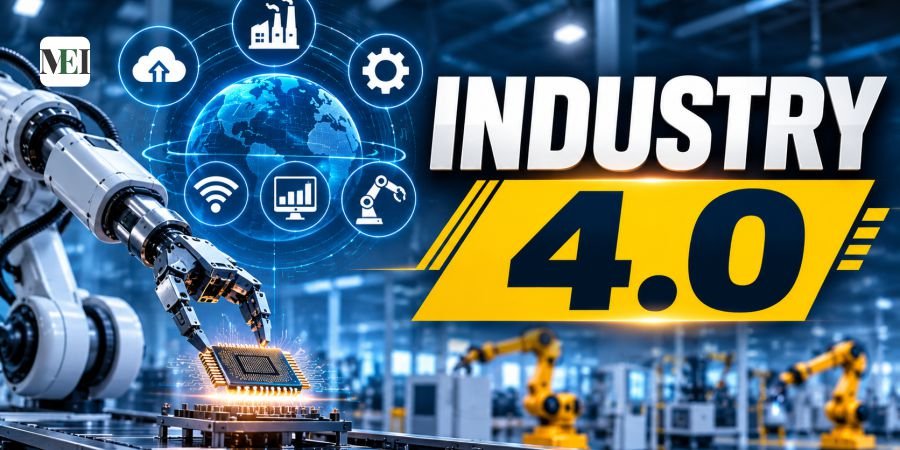
All this is achieved through the combination of artificial intelligence, robotics, Internet of Things (IoT), cloud computing, big data analytics and advanced manufacturing systems.
From Traditional Manufacturing to Intelligent Production
For many years, success in manufacturing was defined by such parameters as production capacity, efficiency of labor and ability to sustain high-quality standards. All of these are still valid, but the modern way to compete within the industry becomes more and more dependent on the ability of the organization to leverage technology. With Industry 4.0, manufacturers receive an opportunity to create interconnected production settings where machines, devices, software and people exchange information constantly.
One of the clearest examples of this evolution is smart factories. The sensors that are placed in different parts of production plants provide information about performance, temperature, conditions and output. This makes it possible for managers to get to know everything that happens in their plants not just through manual monitoring. Automated systems may also be used to adjust some parameters of production to ensure consistency and prevent unnecessary downtime.
Another useful feature of Industry 4.0 is predictive maintenance. Instead of waiting until machines break down or following fixed maintenance schedule, manufacturers can analyze data from devices and detect the signs of problems.
The Technologies Driving Industrial Transformation
What distinguishes Industry 4.0 is the combination of many sophisticated technologies in one operationally-oriented system.
AI can help companies deal with the analysis of complicated data and make patterns and decisions that usually take much time and effort. ML tools get better in their performance as they work with more operational data; hence, they are useful in quality control, prediction of demand and production planning.
IoT technology enables industrial equipment and devices to connect to each other and communicate continuously between physical and digital platforms.
Robotics and intelligent automation have also had an effect on the way industries operate. Contemporary robots can handle repetitive, precision, and physically strenuous tasks without fail. Cobots, which is another name for collaborative robots, can operate side-by-side with human workers, helping to enhance productivity while enabling people to concentrate on supervisory and problem-solving roles.
Cloud computing and sophisticated data analytics enable the necessary technology that can handle the massive amount of data created by connected systems.
Building Greater Efficiency and Business Resilience
The advantages of Industry 4.0 go far beyond just the manufacturing process itself. Organisations can enhance their supply chain visibility, optimize their inventory management processes and adapt to changes in customers’ needs. Thanks to the availability of live data, businesses will be able to detect problems early, find alternative sources of supplies and change the schedule of production depending on the demand.
Another technology that is becoming available in the Industry 4.0 era is digital twins. These virtual replicas of tangible items, machinery or the whole production system allow an organisation to examine how things would operate under certain conditions and whether it is wise to make any changes in the real world.
With this revolution, businesses will also be able to offer a more personalized manufacturing service to its customers, who today demand goods that correspond to their unique tastes. Connected production systems can produce smaller batches of products cost-effectively.
The Human Dimension of Industrial Innovation
Although the use of automation is increasing significantly, the industrial revolution does not simply entail a substitution of humans with machines. It is dependent upon the creation of a labour force which is skilled in using and improving sophisticated technological systems.
The requirements of industries are transforming under Industry 4.0. There is an increasing need for workers who know how to use technology, understand data, cybersecurity, automation and connected devices. Workers in engineering, manufacturing management and technical positions must gain skills in operating within industrial and digital landscapes.
It is imperative that businesses invest in their employees’ training and education. Training programs and other learning programs will help workers adapt to new roles. Companies which engage their workers during their digital revolution process will be able to build trust, stimulate creativity and achieve adoption.
Challenges That Businesses Must Address
Transition to connected manufacturing involves certain difficulties. Expensive implementation, old infrastructure, problems with integration and lack of specialists are capable of hampering the process. Small companies, especially, will find it hard to implement new technology unless the benefits from doing so become clear.
Cybersecurity needs special mention. Connected machines become more susceptible to attacks. In case of an attack, sensitive data, production processes and operational safety are endangered. Therefore, companies should focus on creating a secure network, updating systems, accessing data and raising awareness among employees.
Data governance is another essential element. The company should have effective procedures for collecting, storing, protecting and using data. Any investment in technology should be guided by the business strategy of the company.
Preparing for the Next Industrial Chapter
Industry 4.0 is neither an individual technological innovation nor a fad in business. It is a transformation of the very nature of industries in their approach towards production, management, innovation and competitiveness. The potential benefits of Industry 4.0 are only realized when companies link investments in technology to specific business goals.
Further phases of industrial evolution will see increased focus on automation, intelligence, sustainable production and cooperation between humans and machines. In this process, the ability of companies to adapt will become an important factor in ensuring success.
At the end of the day, Industry 4.0 gives industries the chance to challenge themselves and create a more robust model of operation. Companies that will approach this transformation in the right way will be able to increase productivity, develop better relations with customers and find opportunities for new growth.