There can be times in spaceflights when the greatest risk occurs before the actual flight begins. Apollo 12’s crew experienced this situation just about a minute after take-off when their Saturn V was hit by lightning resulting in what started as a normal launch process changing to salvaging the malfunctioning systems on board the spacecraft; thus, this mission in the future would scroll down history as one of the best lunar landings but it could have ended much earlier over Florida.
On November 14, 1969 Pete Conrad, Alan bean, and Richard Gordon took off from Kennedy Space Center at 11.22 am EST during a cloudy and rainy day. The spacecraft was struck by lightning shortly after 36 seconds of flying and then there was another strike at the mark of 52 seconds. As reported by NASA, as a result of the first strike the three fuel cells of the command module got disconnected and a series of electrical alarms were set off, while the second hit led to the malfunction in the guidance system.
When Apollo 12 Was Suddenly in Trouble
The unsettling aspect was not that lightning struck a space vehicle; it was what happened afterwards. The astronauts caught sight of a bright flash of light followed by the emergence of alert lights on the control panels. Simultaneously, Mission Control was getting important information that was however difficult to analyze. The spacecraft had lost several key electrical functions, losing entire control that would be critical for the mission to the Moon.
What makes Apollo 12 truly remarkable is that Saturn V kept on doing its job. The giant rocket continued to climb even as the astronauts faced electrical malfunctions. This was something that helped the engineers a lot. Although the astronauts were still being pushed upward by the launch vehicle, Mission Control had to determine whether the spacecraft would still function.
This was possible thanks to John Aaron, a young electrical and environmental engineer at the Mission Control. He realized what type of problem could cause strange readings and found out that the equipment used in the spacecraft was responsible for this. He recalled a rather unusual solution that had been implemented during the training simulation: by changing the operation of this piece of equipment from its usual mode to the switching the SCE from its normal setting to auxiliary mode could restore the necessary information.
This information resulted in one of the most well-known technical calls in Apollo 12’s history. Aaron suggested that the staff use AUX instead of SCE. Alan Bean made the adjustment since he knew where the seldom used control was. Mission Control was able to see the spacecraft more clearly when the telemetry started to return to normal. NASA subsequently stated that recovery from the lightning-induced failure depended on Aaron’s memory of that obscure system behavior.
The Weather Was More Complicated Than It Looked
It might seem that sending the shuttle into the storm was a hasty idea. Nevertheless, the truth is more complicated. There was light rain in the area, but that did not mean that there was a classic thunderstorm. NASA recorded a visibility of almost seven miles, an 800-foot cloud ceiling and an overcast of about ten thousand feet.
However, some research later on indicated that the atmospheric conditions were capable of causing issues even though the launch area did not look like a classic thunderstorm from the Earth’s surface. It is also important to mention the rocket itself in this case. A strong times rocket moving through the electrically-powered clouds may behave differently from other aircraft.
The above-mentioned fact became one of the key lessons of the mission. It proved that the weather rules based on visible storms and thunderstorms do not always guarantee safety in every situation.
The Mission Was Not Over
After the initial crisis was resolved, NASA had to do follow-up checks instead of assuming all was alright. The spacecraft stayed in orbit around the Earth as engineers were checking its systems. About two hours and thirty minutes after the launch, the team felt confident enough to accomplish the Trans-Lunar Injection. The S-IVB engine then worked for five minutes and forty-four seconds, ensuring that the spacecraft went into the lunar direction.
This is where the Apollo 12 mission turns from just a story about surviving a lightning strike into another mission. The crew did not just hope for the best and move towards the Moon. They continued with the mission that had been planned in detail, and ultimately reached the lunar neighborhood ready to land on the Ocean of Storms.
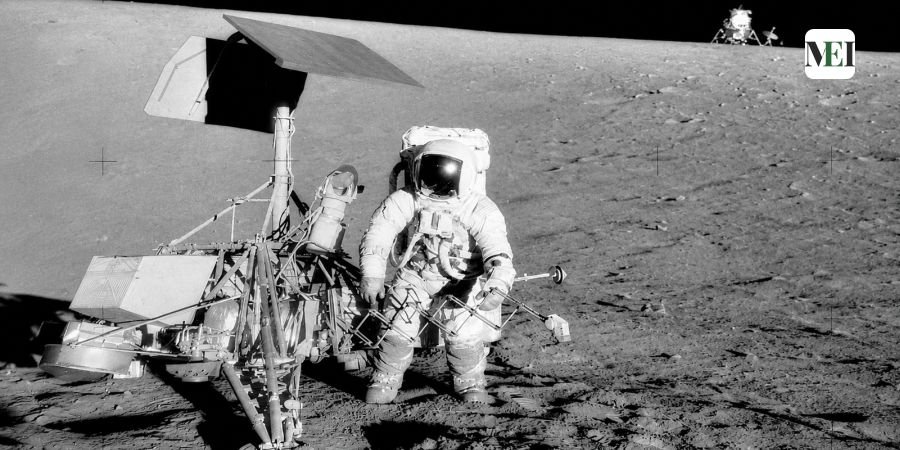
On November 19, Conrad and Bean used the lunar module Intrepid while Gordon was in orbit around the Moon on Yankee Clipper. The landing was extremely precise. The aim of the mission was to show that astronauts could land at a specific point of the Moon instead of just landing in a vast area. They landed so close to the Surveyor III spacecraft that they could go there and walk over and retrieve parts of it for examination back on Earth.
Why the Lightning Incident Still Matters
The lesson from Apollo 12 is indeed that although NASA was fortunate to encounter unexpected factors, preparation played a crucial role. In fact, Aaron had already experienced the SCE issue during a simulation almost a year prior, and Bean knew exactly the position of the switch in question; in the end, Mission Control had the requisite expertise to understand the flow of data under pressure.
Spaceflight is usually associated with spectacular images: rockets flying into space, astronauts performing walks on other planets, Earth being visible from Moon, and the like. An uncommon switch seems to satisfy the need of space expeditions in terms of alternate solutions.
Besides, the incident involving Apollo 12 had a far-reaching impact on NASA’s policy concerning launch weather: the lightning incident turned out to be a starting point for investigations into electrical environments of the launch vehicles and specific weather conditions for the launch.
Apollo 12 deserves to be remembered for its successes alongside the more well-known lunar missions because it was not just the powerful rocket or sophisticated spacecraft that made the mission successful. That success rested on the ability of people to identify a new and unfamiliar situation and determine which course of action to take, which helped them solve the problem.
What happened was that lightning did not hinder Apollo 12 to reach the Moon successfully. The crew carried out the 10-day mission, landed precisely, walked on the lunar surface and returned to the Earth on November 24. However, the most notable moment is the moment of launch when whatever depended on the switch that nobody thought about.
This is true that Apollo 12 leaves behind a fairly human legacy. The truth is that in space exploration there are lots of machines and lots of technologies, but in case something goes wrong, it is important to take action.