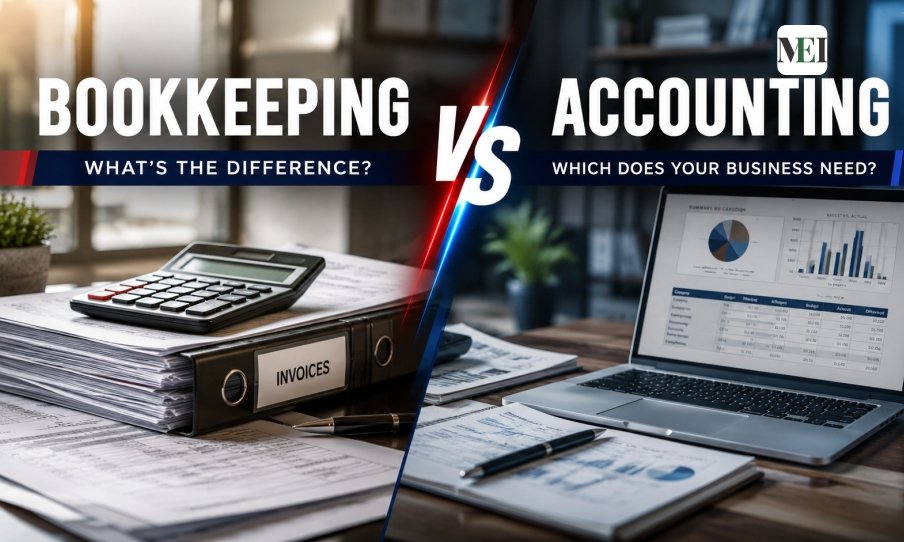
Every successful business has properly kept financial records. However, many companies make a critical mistake in confusing the terms bookkeeping and accounting. Although these two concepts are closely intertwined, there is a meaningful difference between the two in terms of the responsibilities and the skills required for each. Understanding the difference and the relationship between the two is crucial in order to be able to distinguish the two functions and determine which is required for your business.
For any aspiring entrepreneur, the question of bookkeeping vs. accounting is bound to arise at some point. Although they are commonly used interchangeably, the two terms actually refer to different things. The distinction is rather simple, although many people tend to mix the two. It is important to remember that the two practices are closely related and complement each other while having different roles. Therefore, being able to tell them apart is vital in understanding what your business really needs.
Bookkeeping refers to the most basic form of financial accounting. Any business records that deal with the financial aspect of an organization fall under this term. A bookkeeper is responsible for maintaining accurate and up-to-date financial records of a company in order to reflect its current financial state. In essence, what a bookkeeper does is record all financial transactions carried out by the company. All invoices, receipts, revenue, expenses, and any other transactions must be meticulously recorded and organized by a bookkeeper. The accuracy of bookkeeping is of utmost importance, as it serves as the foundation for the financial accounting of the company. In today’s modern economy, most bookkeeping practices are done by computers using specialized accounting software.
Without proper bookkeeping, businesses may struggle to track cash flow, identify overdue payments, or prepare financial reports. Clean financial records also simplify tax preparation and make audits less stressful.
What Is Accounting?
Accounting takes the financial information collected through bookkeeping and transforms it into meaningful insights. Rather than simply recording transactions, accountants analyze financial data, prepare reports, interpret trends, and provide strategic advice that supports business growth.
Accounting involves preparing financial statements, calculating taxes, managing budgets, forecasting future performance, and ensuring compliance with financial regulations. Accountants also help business owners understand profitability, identify cost-saving opportunities, and make investment decisions based on reliable financial analysis.
This is where bookkeeping vs accounting becomes important. While bookkeeping focuses on maintaining financial records, accounting focuses on understanding what those records reveal about the health of the business. Both functions are essential, but they require different expertise and serve different objectives.
Key Differences Between Bookkeeping and Accounting
The easiest way to understand bookkeeping vs accounting is to think of bookkeeping as collecting data and accounting as interpreting it. A bookkeeper records financial events exactly as they occur, whereas an accountant uses those records to prepare reports and offer recommendations.
Bookkeeping generally follows standardized processes with an emphasis on accuracy and organization. Accounting, however, requires analytical thinking, financial planning, and knowledge of tax laws and reporting standards. While bookkeepers maintain the day-to-day financial records, accountants evaluate financial performance and help shape long-term business strategies.
Another important distinction lies in decision-making. Bookkeeping ensures financial information is available, while accounting uses that information to guide decisions such as expanding operations, reducing expenses, or improving profitability. This collaborative relationship allows businesses to maintain reliable records while also planning for future growth.
Technology has also changed how both professions operate. Automated bookkeeping software can record transactions, generate invoices, and reconcile bank statements with minimal manual effort. Accountants, meanwhile, use advanced financial tools to analyze trends, prepare forecasts, and develop strategies that align with business objectives.
Which One Does Your Business Need?
For most businesses, the answer isn’t choosing one over the other. Instead, they need both. Bookkeeping creates the financial foundation, while accounting builds on that foundation to support planning and informed decision-making.
Small startups often begin with basic bookkeeping to keep track of income and expenses. As the business grows, accounting becomes increasingly important for budgeting, tax planning, financial reporting, and securing loans or investors. Larger organizations typically employ dedicated bookkeeping and accounting professionals who work together to maintain financial accuracy and support strategic planning.
When comparing bookkeeping vs accounting, it’s also helpful to consider the complexity of your business. A freelancer with limited monthly transactions may only require bookkeeping services and occasional accounting assistance during tax season. A growing company with employees, inventory, and multiple revenue streams will benefit from continuous accounting support alongside regular bookkeeping.
Outsourcing these functions has become a popular option for businesses seeking expertise without hiring full-time staff. Professional bookkeeping services ensure accurate records, while experienced accountants provide valuable insights that improve financial decision-making and regulatory compliance.
Ultimately, understanding bookkeeping vs accounting allows business owners to allocate resources more effectively and recognize the value each function brings. Rather than viewing them as interchangeable, it’s better to see them as complementary parts of a complete financial management system.
A business with accurate books but no financial analysis may miss opportunities for growth. Likewise, even the best accounting advice becomes unreliable if the underlying financial records are incomplete or inaccurate. Together, bookkeeping and accounting create a clear picture of financial performance, helping businesses remain organized, profitable, and prepared for future challenges.
Whether you’re launching a startup or managing an established company, investing in both accurate bookkeeping and professional accounting can strengthen financial control and improve long-term success. Understanding bookkeeping vs accounting is more than learning the difference between two financial terms—it’s about building a stronger financial foundation for every stage of your business.