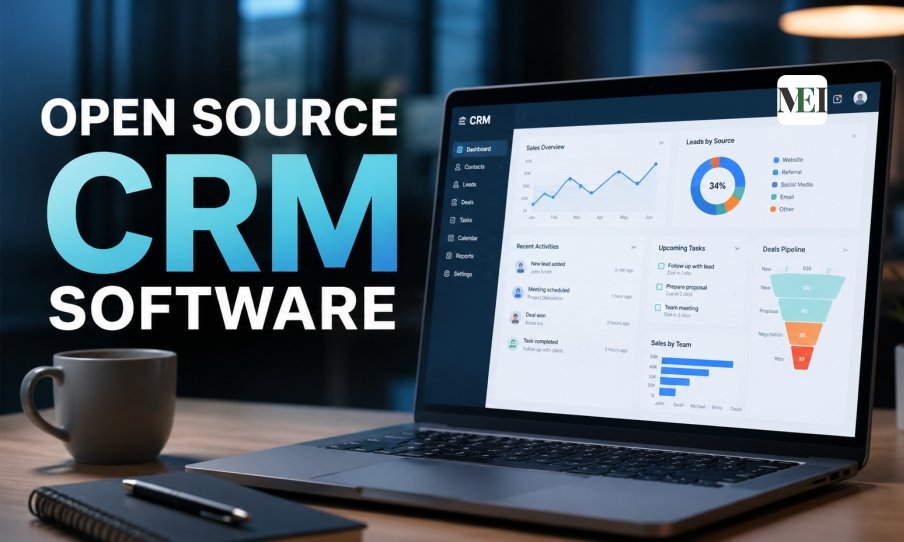
Managing customers’ relationships has become an essential pillar for every company’s existence. Whether a company is a small or medium-sized enterprise or an established business, any organization can benefit from using open source CRM software. Managing leads, customer relationships, sales pipelines, and support is a difficult task, so a tool that can automate and streamline these processes is critically important. At the same time, most traditional customer relationship management systems require a company to subscribe to them, thus creating ongoing costs. Moreover, such software is usually not customizable, making it unable to accommodate specific business needs. On the other hand, open source CRM software allows users to customize the system and remove any limitations imposed by the company that provides the product. That is why these tools are becoming more popular among companies that want to manage their sales pipelines and customers’ relationships without any restrictions.
The Reasons Why Companies Are Shifting Toward Open-Source Software
In the modern environment, every organization wants to be able to scale its operations while minimizing costs. With the help of traditional CRM systems, companies are not able to do that since the software often requires organizations to pay additional fees whenever they want to add new users or locations. On the contrary, there are no such limitations with open source CRM systems. Additionally, such tools offer greater flexibility since they can be modified to suit the needs of a particular business.
The reason for that is the fact that such software’s source code is available to the public, meaning that developers can customize it in accordance with their needs. For businesses with rather unique requirements that outsource CRM software cannot address, this can be an important advantage.
Security is another compelling reason. Although some assume open-source software is less secure, the opposite is often true. Active developer communities regularly identify vulnerabilities and release updates, allowing businesses to benefit from continuous improvements. Organizations also have complete control over how customer information is stored and managed, making compliance with privacy regulations much easier.
Features That Support Long-Term Growth
A reliable CRM does much more than store customer information. It serves as a central hub for sales, marketing, and customer service activities. Most open source CRM software platforms include lead management, contact organization, sales pipeline tracking, reporting dashboards, workflow automation, email integration, and customer support management.
Many solutions also support third-party integrations with accounting software, marketing automation platforms, communication tools, and e-commerce systems. These integrations eliminate manual work and improve collaboration between departments.
Another significant benefit is customization. Businesses can modify dashboards, automate repetitive tasks, create personalized reports, and develop additional modules tailored to their industry. Whether a company operates in healthcare, education, manufacturing, or retail, an open-source CRM can be configured to match operational needs rather than forcing teams to adapt to rigid software limitations.
As customer expectations continue to evolve, organizations require systems that enable faster responses and better service. A customizable CRM empowers employees to access complete customer histories, monitor ongoing conversations, and resolve issues more efficiently, ultimately strengthening customer relationships.
Choosing the Right CRM for Your Business
Selecting the ideal CRM requires careful evaluation of business goals and technical capabilities. While many platforms provide similar core features, they differ in usability, scalability, community support, and customization options.
Before implementation, businesses should assess how many users will access the system, what integrations are necessary, and whether they have the technical resources to manage self-hosted applications. Some organizations choose cloud-hosted deployments for easier maintenance, while others prefer on-premise installations for greater control over data.
When comparing options, businesses should also examine documentation quality, developer activity, update frequency, and available community support. Active communities often contribute plugins, extensions, and security improvements that significantly enhance the software over time.
Another important consideration is employee adoption. Even the most feature-rich CRM will fail if users find it difficult to navigate. Selecting a platform with an intuitive interface and straightforward workflows can improve productivity and encourage consistent usage across departments.
The Future of Customer Relationship Management
Digital transformation continues to reshape how businesses interact with customers. Artificial intelligence, predictive analytics, automation, and personalized communication are becoming standard features in CRM platforms. Many open-source communities are already incorporating these innovations into their projects, making advanced capabilities accessible without premium subscription costs.
As remote work and hybrid teams become increasingly common, businesses also require systems that support collaboration from anywhere. Modern open source CRM software solutions are evolving to provide mobile access, cloud synchronization, role-based permissions, and real-time reporting that help distributed teams stay connected.
The growing emphasis on data ownership further strengthens the appeal of open-source platforms. Organizations are becoming more cautious about relying on vendors that control their customer information. By maintaining ownership of infrastructure and data, businesses gain greater independence while reducing long-term operational risks.
Ultimately, adopting open source CRM software is more than a cost-saving decision. It represents a strategic investment in flexibility, customization, and long-term scalability. Companies can build customer management processes that align with their unique objectives instead of adapting their operations to fit restrictive software.
For organizations looking to improve customer engagement, streamline internal workflows, and maintain complete control over their business data, open-source CRM platforms provide a reliable foundation for sustainable growth. As technology continues to evolve, these solutions will remain an attractive option for businesses seeking innovation without sacrificing ownership or adaptability.