Waste management is no longer only about what happens after something is discarded. The field now asks a larger question: how can materials be recovered, resources used more intelligently, and waste systems designed to support a more sustainable economy? That shift has placed environmental expertise at the heart of conversations around resource recovery, circularity, and long-term development.
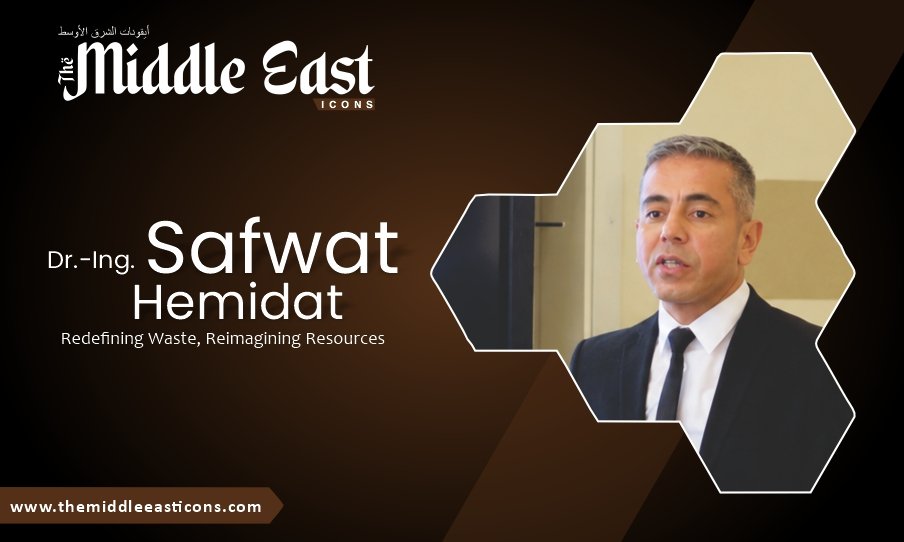
At the centre of this work is Dr.-Ing. Safwat Hemidat, Senior Manager at the Saudi Investment Recycling Company (SIRC – PIF), an experienced environmental engineer and technical expert with more than 20 years of experience across the Middle East and North Africa. His professional focus spans solid waste management, the circular economy, and sustainable resource recovery, areas that increasingly intersect with the way cities, industries, and economies think about materials and their value.
Within SIRC’s Technology & Innovation Department, Dr.-Ing. Safwat Hemidat leads strategic projects covering recycling, waste-to-energy, and integrated waste management solutions. His work connects technical knowledge with practical efforts to advance resource recovery and support the ambitions of Saudi Arabia’s Vision 2030. Rather than viewing waste as an isolated environmental concern, his field of expertise reflects a broader understanding of how effective systems can recover value from materials while contributing to more sustainable development.
His two decades of experience provide a valuable perspective on the technical and strategic considerations shaping the sector across the region. His journey offers an opportunity to explore the ideas, challenges, and innovations influencing the future of waste management and resource recovery in Saudi Arabia and the wider MENA region.
Seeing Opportunity in What Others Discard
Environmental engineering appealed to Dr.-Ing. Safwat Hemidat because it offered an opportunity to solve problems with a direct and lasting impact on society. Waste management, in particular, captured his interest because he came to see it as far more than an environmental concern. It is an engineering, economic, social, and resource-management challenge. Pasted markdown
Across more than two decades, his perspective has evolved alongside the sector. He began by viewing waste primarily through the lens of environmental protection and engineering. Over time, he came to recognise a broader opportunity: waste does not necessarily mark the end of a material’s life. It can represent the beginning of another resource cycle.
That perspective has shaped his work across the Middle East and Europe, spanning waste management, material-flow analysis, resource recovery, waste-to-energy, alternative fuels, and integrated waste-management systems. What continues to motivate him is the complexity of the challenge. There is no single technology or universal solution. The engineering task is to design systems that work technically, economically, environmentally, and operationally while continuing to create value over the long term.
Looking Beyond Disposal
The shift from conventional waste management toward resource recovery began with a simple realisation for Dr.-Ing. Safwat Hemidat: the word “waste” can conceal significant value. Discarded materials may contain recyclable resources, organic matter, chemical energy, or other recoverable components. Treating collection and disposal as the only objectives means losing those resources while creating additional environmental and economic costs.
Resource recovery changes the central question. Instead of asking how waste should be disposed of, the focus becomes understanding what value can be recovered from a material and identifying the best pathway to achieve it. That approach naturally leads to recycling, organic-resource recovery, material recovery, refuse-derived fuel, energy recovery, and other circular-economy solutions.
Dr.-Ing. Safwat Hemidat does not believe in technology for technology’s sake. Circularity is not about finding one perfect technology. It is about designing the right system for the right waste stream, market, environment, and community.
Technology Must Fit Its Context
Within SIRC’s Technology & Innovation Department, Dr.-Ing. Safwat Hemidat applies the principle that successful technology cannot simply be copied. It has to be understood and adapted. International experience provides valuable reference points, offering lessons from technologies, projects, successes, and failures around the world. Yet Saudi Arabia has its own waste characteristics, climate, infrastructure, regulatory environment, markets, logistics, and operational realities.
The objective, therefore, is not simply to import technology. It is to evaluate technologies critically, understand the conditions under which they perform, and determine how they can be adapted to create value in the Saudi context. That requires combining international best practice with local knowledge.
The most advanced technology is not necessarily the right choice. The right technology is the one that delivers the required environmental outcome at the appropriate scale, with sound economics, and can be operated reliably for decades.
A Fundamental Shift in Saudi Waste Management
Dr.-Ing. Safwat Hemidat has witnessed a fundamental transformation in Saudi Arabia’s approach to waste and resource management. Waste management is increasingly being viewed not simply as a conventional municipal service, but as a strategic component of environmental sustainability, resource efficiency, and economic development.
Greater attention is being given to landfill diversion, recycling, resource recovery, alternative fuels, waste-to-energy, private-sector participation, technology, data, and professionalised operations.
One of the most significant changes, in his view, is the move toward integrated thinking. Waste streams cannot be considered in isolation. Collection, treatment, recycling, energy recovery, markets, infrastructure, regulation, and final disposal need to be understood as parts of one interconnected system.
Saudi Arabia is at an important stage of this transformation. Its scale, ambition, investment potential, and institutional momentum create an opportunity to develop a modern resource-management system and potentially establish a regional reference point for sustainable resource recovery. Pasted markdown
The Place of Waste-to-Energy
Dr.-Ing. Safwat sees waste-to-energy as an important component of integrated resource recovery, but not as a substitute for recycling. The hierarchy should begin with waste prevention and reduction, followed by reuse, recycling, and the recovery of materials and organics wherever technically and economically feasible. Energy recovery can then provide a valuable pathway for residual fractions that cannot reasonably be recovered through higher-value routes.
The real opportunity lies in integration. A well-designed waste-to-energy system can reduce dependence on landfill, recover energy from residual waste, and provide a reliable destination for materials with limited recovery options.
Yet the quality of the wider system depends on sound waste data, suitable pre-treatment, stable feedstock, strong environmental controls, reliable operations, and a viable energy market. The objective should not be to maximise energy recovery, but to maximise the overall value recovered from the waste stream.
Making Organic Recovery Work at Scale
Organic waste represents a significant resource-recovery opportunity across the region, but Dr.-Ing. Safwat believes scaling such solutions requires much more than installing treatment technology. Source separation, contamination, collection systems, moisture and seasonal variability, pre-treatment, feedstock consistency, product quality, and reliable markets for recovered products all present important challenges.
A technology can be technically proven and still fail commercially when the surrounding value chain is weak. Organic-resource recovery therefore needs to be considered across the entire chain, from collection and feedstock preparation through treatment, quality control, product development, markets, and end use. The facility is only one part of the solution. The value chain is the real system.
Data as the Foundation of Planning
Dr.-Ing. Safwat describes waste data as the engineering foundation of waste-management planning. Without knowing what is actually in the waste, it is difficult to design the right infrastructure. Quantities, composition, moisture, calorific value, seasonal variation, geographic distribution, and contamination levels can all influence technology selection and project economics. This becomes particularly important when evaluating recycling, biological treatment, RDF production, or waste-to-energy.
Technology designed around incorrect assumptions can lead to unsuitable equipment, unrealistic operating costs, poor performance, and significant investment risk. Reliable waste data does more than describe a problem. It enables better decisions.
Good data shifts waste management from assumption-driven planning toward evidence-based engineering, an approach that becomes even more important at national scale because infrastructure decisions can influence investment and environmental performance for decades.
Learning from International Experience
Dr.-Ing. Safwat’s collaborations with German universities and institutions have significantly influenced his approach to environmental engineering and resource management. Germany’s experience demonstrated to him that successful waste management depends on the interaction between science, regulation, standards, infrastructure, markets, operational discipline, and long-term planning.
His academic experience also strengthened his belief in evidence-based decision-making. Research has value when it helps deepen understanding of a problem and ultimately leads to better practical decisions.
At the same time, he does not view international best practice as a template to copy. The more valuable lesson is to understand why something worked elsewhere and then determine what should work in a different context. That philosophy continues to guide his work.
Designing for Decades, Not Just Construction
One of the mistakes Dr.-Ing. Safwat sees in waste and resource recovery infrastructure is an excessive focus on construction at the expense of the decades of operation that follow. CAPEX and technology selection matter, but long-term viability also depends on feedstock security, OPEX, maintenance, spare parts, skilled people, logistics, regulatory compliance, product quality, market demand, and the ability to respond to changing waste characteristics.
Business-model resilience is equally important. A facility may be technically strong, but if recovered materials or alternative fuels do not have stable markets, the project can struggle.
Dr.-Ing. Safwat therefore believes major projects should be evaluated from a life-cycle perspective. Success is not simply whether a facility can be built. It is whether it can continue delivering environmental and economic value year after year.
Developing the Next Generation
Dr.-Ing. Safwat encourages younger environmental professionals to remain curious and resist thinking in silos. The future of environmental management will require engineers who understand technology alongside economics, data, policy, business models, markets, and people.
He encourages young professionals to ask three questions: What problem are they really trying to solve? What value can they create? And how can the solution work in the real world?
He also urges them to challenge conventional thinking. The waste sector is changing rapidly, and some of its most important innovations may come from people willing to connect disciplines that traditionally operated separately.
Expertise, in his view, is a journey rather than a destination. The strongest environmental professionals will not simply manage waste. They will design systems that prevent waste, recover resources, create value, and protect the environment.
Waste Management as an Economic Opportunity
Dr.-Ing. Safwat sees integrated waste management as a powerful enabler of Saudi Arabia’s sustainability ambitions and Vision 2030. The Kingdom is undergoing a broad transformation, and waste and resource management is becoming an increasingly important part of it.
Saudi Arabia has an opportunity to develop a modern, integrated, future-ready resource-management system combining recycling, resource recovery, alternative fuels, organic-resource recovery, waste-to-energy, and responsible residual-waste management.
The Kingdom’s scale, investment capacity, national vision, and growing focus on innovation and sustainability create conditions in which advanced technologies, new business models, local capabilities, and private-sector investment can come together at meaningful scale.
Integrated waste management can also support economic diversification by creating new industries, developing green jobs, strengthening local supply chains, and turning discarded materials into valuable resources. It is therefore both an environmental agenda and an opportunity for economic development and innovation.
Dr.-Ing. Safwat believes Saudi Arabia can go beyond adopting international best practices by developing its own model of integrated resource management, designed around its environmental, economic, and geographical context and capable of serving as a reference for the wider region. Pasted markdown
Recognition as a Responsibility
Receiving Premium Residency under the Special Talent Category represents both a personal honour and a professional responsibility for Dr.-Ing. Safwat. Personally, he sees it as meaningful recognition of the contribution he has made during his professional journey in Saudi Arabia.
Professionally, it reinforces his commitment to contributing to the Kingdom’s transformation in environmental management, resource recovery, and sustainability. He views recognition as a responsibility rather than simply an achievement.
It motivates him to continue transferring knowledge, supporting innovation, developing practical solutions, and helping build capabilities that can create lasting impact. He remains grateful for the opportunities Saudi Arabia has provided and for the people and organisations that have supported his professional journey.
His ambition is to ensure that his experience and knowledge continue to create tangible value for Saudi Arabia and the wider region. The greatest recognition, he believes, is not a title or an award, but knowing that his work contributes to a more sustainable future.
A Career Focused on Resource Value
Looking toward the next stage of his career, Dr.-Ing. Safwat wants to accelerate the transition from waste management to resource management. In Saudi Arabia, he hopes to contribute to projects that combine sound engineering, technology, innovation, commercial viability, and measurable environmental outcomes. He also wants to support the development of local expertise so that the Kingdom can increasingly become a centre of knowledge and innovation in circular economy and resource recovery.
Across MENA, he sees considerable potential. Countries face similar challenges but have different waste characteristics, infrastructure, economics, and priorities. That creates opportunities to share knowledge, develop regional partnerships, and adapt solutions rather than simply replicate them.
Dr.-Ing. Safwat does not want his professional legacy to be defined only by the facilities or projects on which he has worked. He would rather see it reflected in the systems he helped improve, the knowledge he helped transfer, the professionals he helped develop, and the resources recovered through that work.
His guiding principle is clear: the region should stop thinking of waste as something it needs to manage and start thinking of resources as something it cannot afford to waste. Pasted markdown