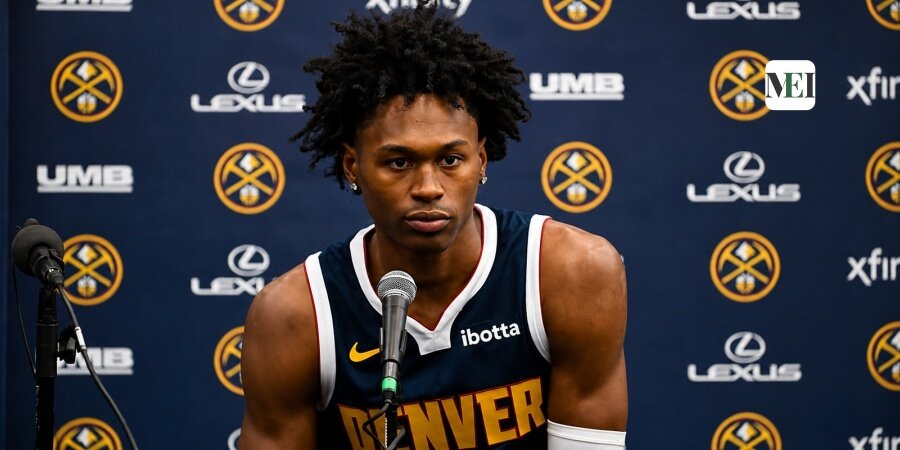
The Peyton Watson contract has turned into one of those more interesting things about the 2026 NBA offseason, not only because of its $88 million headline number, but also because it shows how fast the market can swing for a young two-way wing. Watson went into free agency after a strong breakout fourth season with the Denver Nuggets. He drew attention from several clubs and eventually made his way to the Cleveland Cavaliers via a sign-and-trade.
This new arrangement puts Watson on a four-year, $88 million deal with Cleveland, including a player option and a trade kicker. The whole agreement came together after Denver couldn’t agree on an updated contract with its restricted free agent, so it turned into a multi-team sequence that also pulled in the Los Angeles Clippers.
The Peyton Watson Contract and the Numbers Behind It
The $88 million agreement reads like an average annual value of about $22 million. But honestly, the bigger point is that it shows a substantial jump from the five-year, $70 million contract Denver reportedly offered Watson in July. That earlier thing would’ve still averaged about $14 million annually. So yeah, the spread between those numbers basically shows the leverage Watson pulled in free agency.
The Denver offer, as it was described, valued him at something like $14 million per season, while the Cleveland agreement he ended up signing raised that annual amount to $22 million.
In other words, it’s an increase of approximately $8 million per year, or roughly 57% compared with the annual value of Denver’s reported proposal. Also the contract has a player option, which gives Watson extra say in what happens next. Then there’s the trade kicker as well, serving as another financial safeguard in case he moves later.
Why Watson Became a $22 Million Player
The money case starts with his 2025-26 showing. Watson showed up in 54 games, started 40, and averaged 14.6 points, 4.9 rebounds and 2.1 assists per match. He hit 49.1% from the field, 41.1% from three-point range, and 73.0% at the stripe. That 41.1% mark from deep wasn’t just a number; it was a noticeable upgrade for someone whose scoring, before, had been a bit more uneven when it came to outside looks. And the shot diet, honestly, looked different too. Watson made 81 threes in the 2025-26 run, up from 48 in 2024-25. So he grew his made threes by 33 (roughly 69%) and also became a bigger part of the offence in a more tangible way.
On top of that, his playing time rose to 29.6 minutes per game, up from 24.4 in the previous season. That change kind of lines up with a wider shift in what he was, really. He wasn’t only that young defensive athlete trying to get comfortable on the edges of Denver’s rotation anymore. Instead, he settled into being a regular starter and a more reliable offensive option.
Denver’s Decision and the Sign-and-Trade
The Peyton Watson contract got folded into a bigger roster, and a money move for Denver, you know. Instead of just keeping Watson around, the Nuggets ended up doing a sign-and-trade that sent him to Cleveland. As for what Denver actually gets, they reportedly receive an unprotected 2031 first-round pick from Cleveland, plus a 2032 second-round pick from Sacramento. Meanwhile, Cleveland is said to send Max Strus to the Clippers as part of the same overall swap.
It’s a move that really shows how tangled the economics of NBA roster building can get. Denver already has a bunch of big, long-term obligations, including major contracts for Nikola Jokić, Jamal Murray, Aaron Gordon and Christian Braun. Basketball-Reference has Denver’s 2026-27 payroll sitting at roughly $217.7 million. So, in that kind of financial picture, any extra long-term commitment matters more than it normally would.
What Cleveland Is Betting On
For Cleveland, the Peyton Watson contract feels like a bet on someone whose development curve is still climbing, at least by a good amount. Watson is headed into his fifth NBA season after going 30th overall in the 2022 NBA Draft. He’ll be 23 during the 2025-26 season, and he put up career highs in a bunch of statistical categories.
More importantly, he showed he can matter on both ends of the court , not just one side. So the main question now really is consistency, not potential. A 14.6-point season paired with 41.1% three-point shooting sets up a solid baseline, but Cleveland is going to need that output to stay steady and not fade.
His defensive versatility, size, and athleticism give him a strong starting point. Still, it’s his improved perimeter shooting that could end up deciding if the $22 million per year investment looks more like a bargain, or instead a premium gamble.
The Bigger Meaning of the Deal
The Peyton Watson contract is ultimately less about a single season and more about the economics of trying to project what young NBA talent will look like later. Watson went from a developing rotation body to a 14.6-point starter in basically one season, and it felt like everything in the profile shifted. His three-point output jumped pretty quickly, his minutes climbed, and his market broadened outside of Denver. The end result, a four-year, $88 million agreement with Cleveland, shows how fast a player’s value can flip when production, age, positional versatility and that extra upside all land together at once.
For the Cavaliers, the math reads almost plain: pay now for the chance that Watson becomes meaningfully more valuable in the future. For Denver, the thought process was different; they had to keep financial manoeuvring room while turning a departing restricted free agent into future draft capital.
So yeah, the Peyton Watson contract is a solid case study in how teams build in the modern NBA. At $22 million per year, Cleveland isn’t just buying Watson’s 2025-26 numbers. They’re buying the next version of him that those numbers hint he can grow into.