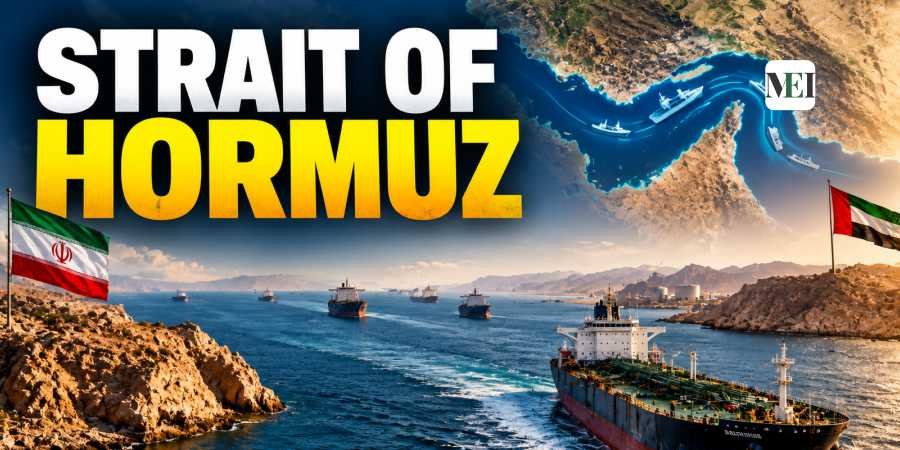
A narrow stretch of water between Iran and the Arabian Peninsula can influence the price of petrol in Mumbai, the cost of electricity in Japan and the availability of natural gas in South Korea. That is the significance of the Strait of Hormuz, one of the world’s most important energy chokepoints. Its geography is small, but the volume of energy passing through it connects the Middle East directly to the economies of Asia.
The scale is striking. The International Energy Agency says around 20 million barrels per day of crude oil and oil products moved through the Strait of Hormuz in 2025, representing roughly a quarter of global seaborne oil trade. About 80% of those flows were destined for Asian markets, with China, India and Japan among the biggest recipients.
Why the Strait of Hormuz Matters So Much to Asia
The importance of the Strait of Hormuz becomes clearer when the supply chain is followed from the Gulf to an Asian consumer. Oil produced in Saudi Arabia, Iraq, Kuwait, the UAE and other Gulf states may travel through the strait before reaching refineries in China, India, Japan or South Korea. Those refineries then turn crude into petrol, diesel, jet fuel and other products used across transport, manufacturing and households.
This creates an unusual dependence. The IEA estimates that nearly 15 million barrels per day of crude oil, equivalent to almost 34% of global crude oil trade, passed through the Strait of Hormuz in 2025. China and India together received 44% of that crude. Japan and South Korea are also particularly dependent on supplies moving through the waterway.
The result is that Asian energy security is influenced not only by domestic production or government reserves, but also by the safety and reliability of a shipping route thousands of kilometres away.
Oil Is Only Part of the Story
The Strait of Hormuz is equally significant for natural gas. Qatar is one of the world’s major LNG exporters, and much of its production leaves through the strait. The IEA estimates that about 93% of Qatar’s LNG exports and 96% of the UAE’s LNG exports transit the waterway, together representing roughly 19% of global LNG trade.
That matters enormously for countries that use imported LNG for electricity generation and industrial activity. Japan and South Korea have substantial LNG requirements, while India and China have also expanded gas consumption over the years. When shipments become uncertain, buyers may compete for cargoes from the United States, Australia, Africa or elsewhere, pushing prices higher across the wider market.
The impact was visible in 2026. Reuters reported in September that the disruption associated with the conflict had contributed to a loss of around 36 million tonnes of LNG supply and pushed Asian spot prices from about $10 to nearly $30 per million British thermal units. Buyers in China, India and Pakistan responded by seeking alternative supplies and, in some cases, switching toward coal and oil when gas became too expensive.
Why Alternative Routes Cannot Easily Replace It
It might seem that producers could simply send their oil around the Strait of Hormuz. There are alternatives, but their capacity is limited compared with the volume normally handled by the waterway.
Saudi Arabia can use pipelines to the Red Sea, while the UAE has infrastructure connecting its oil fields with Fujairah outside the strait. The IEA estimates that about 3.5 million to 5.5 million barrels per day of crude could potentially be redirected through available bypass capacity. That is substantial, but far below the roughly 20 million barrels per day of oil and products that passed through Hormuz in 2025.
The economics of rerouting can also be painful. Longer journeys mean higher freight, insurance and handling costs. During the 2026 disruptions, Reuters reported that ship-to-ship transfers around the Gulf of Oman became congested, with very large crude carrier charter rates reaching about $1.27 million per day. Chinese and South Korean buyers were among those exploring alternative transfer locations.
So even when oil continues moving, avoiding the chokepoint can make each barrel more expensive.
What It Means for India, China and Japan
The Asian impact is not identical across countries. China has a large refining industry and can draw on domestic production, strategic reserves and a broad portfolio of international suppliers. India has similarly increased its use of Russian crude while also sourcing oil from the Middle East and other regions.
Recent Indian import data illustrate this flexibility. Reuters reported that India’s Russian oil imports fell 16.5% in August 2026 to about 2.1 million barrels per day, while Iraqi supplies increased 25% to around 171,000 barrels per day. India’s refiners have also been examining alternative Middle Eastern sources as disruptions around Hormuz complicate normal purchasing patterns.
Japan and South Korea face a different structural challenge because they depend heavily on imported energy. A disruption therefore affects more than the crude oil market. Higher LNG costs can influence electricity generation, while expensive crude can raise refinery costs and eventually feed into transportation and manufacturing prices.
Consumers Feel the Effects Indirectly
The average consumer may never think about the Strait of Hormuz while filling a vehicle or paying an electricity bill. Energy markets, however, connect those everyday costs to global shipping conditions.
A refinery does not necessarily buy crude at the same price as the international benchmark, and a petrol station does not immediately pass every movement in crude prices to consumers. Taxes, refining margins, inventories, currency movements and government policies all influence final prices. Still, prolonged disruption can work its way through the system.
The same applies to food and manufactured goods. Diesel is essential for trucking, agriculture, shipping and construction. Jet fuel affects airlines and freight networks. Natural gas influences power generation, fertilizer production and industrial processes. A shock at one maritime chokepoint can therefore spread through several layers of the economy.
The 2026 Lesson Is About Resilience
The events of 2026 have demonstrated that the Strait of Hormuz is not simply an oil story. It is a test of how resilient modern energy systems are when a major transport corridor becomes unreliable.
The IEA reported in August that global oil supply remained well below year-earlier levels as disruptions continued, while oil demand forecasts were reduced partly because the closure of the Strait of Hormuz and elevated fuel prices were weakening consumption. The agency also noted that global refining margins had reached exceptionally high levels as product markets tightened.
Yet the market has also shown an ability to adapt. Producers have redirected some exports, traders have searched for alternative cargoes, governments have used strategic reserves and Asian buyers have looked farther afield for crude and LNG. Recent Reuters reporting also shows that Qatar-linked LNG traffic through Hormuz has begun picking up again, with cargoes moving toward India, Pakistan and China.
The deeper significance of the Strait of Hormuz is therefore not that every disruption automatically produces an energy crisis. It is that Asia’s enormous economic machine remains connected to a handful of physical routes that cannot be replaced overnight.
For Asian consumers, the Strait of Hormuz can seem geographically distant, but its influence is remarkably close. The price of energy, the cost of transportation and the availability of gas can all reflect what happens in those narrow waters. The experience of 2026 has reinforced a simple lesson: energy security is not only about having enough fuel. It is also about having enough reliable routes, suppliers and alternatives to keep that fuel moving when one of the world’s most important chokepoints comes under pressure.