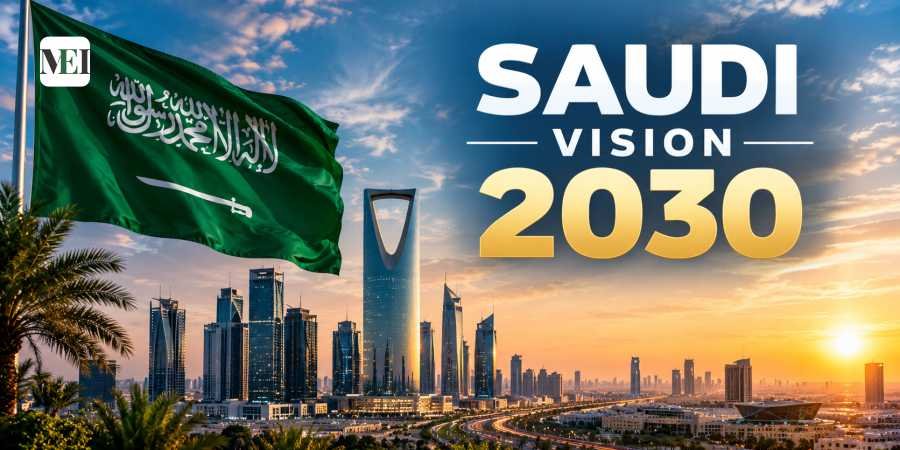
Saudi Arabia’s startup story is changing alongside the country’s broader economic transformation. What was once a market largely associated with oil, large infrastructure projects and government-led development is becoming a much wider environment for software companies, fintech ventures, artificial intelligence, digital services, health technology and other innovation-led businesses. At the center of that shift is Saudi Vision 2030, which has made entrepreneurship, digital transformation and private-sector growth important parts of the Kingdom’s economic agenda.
The scale of the change is already visible. Saudi Arabia’s 2025 Vision 2030 annual report says more than 1,050 technology startups were established over four years, while venture-backed startups raised $2.4 billion. The same report says $670 million was allocated to support startups and more than 20,000 jobs were created through relevant programs. These figures suggest that the startup ecosystem is developing alongside the national transformation rather than existing separately from it.
Saudi Vision 2030 Creates Demand for New Technology
One of the biggest opportunities created by Saudi Vision 2030 is the sheer number of industries undergoing digital transformation. The national agenda includes objectives ranging from healthcare and financial services to tourism, logistics, manufacturing, education and entertainment. That creates demand for companies capable of solving practical problems rather than simply producing another consumer application.
A logistics startup, for example, can potentially benefit from the Kingdom’s ambition to strengthen its position as a global logistics hub. A health-tech company can address digital healthcare delivery or data-driven diagnostics. An enterprise software provider can help organizations automate processes and manage increasingly complex operations.
The opportunity becomes particularly interesting when startups develop technology that can be used beyond Saudi Arabia. The national strategy explicitly includes ambitions to develop promising local companies into regional and global leaders while supporting innovation and entrepreneurship.
The Funding Environment Has Become More Sophisticated
Capital is another important part of the Saudi Vision 2030 startup ecosystem. Saudi Arabia’s venture market recorded a particularly strong 2025, with MAGNiTT reporting a 188% year-over-year increase in venture funding and a 41% rise in deal activity. Saudi Arabia remained the leading MENA market by deal count in the first quarter of 2026, even though funding and deal volume declined from the unusually strong levels recorded a year earlier.
That last point matters. Startup founders should not interpret government support and strong historical funding as a guarantee that every venture will receive capital. The 2026 market has become more selective, with MAGNiTT reporting that Q1 funding fell 62% year over year and deal volume declined 39%. Investors are still active, but the quality of the business model, market opportunity and ability to scale matter.
The funding landscape is also becoming more locally anchored. MAGNiTT reported that local investors represented 60% of active Saudi investors in Q1 2026, while international participation fell to 15%. For founders, that makes understanding local customers, regulations and commercial networks increasingly important.
Saudi Vision 2030 Is Expanding the AI Opportunity
Artificial intelligence is becoming one of the most visible areas of opportunity within Saudi Vision 2030. The Kingdom is investing heavily in digital infrastructure and seeking to establish itself as a significant technology hub, creating potential demand for AI applications across government services, finance, healthcare, energy, industrial operations and consumer platforms.
The wider MENA venture market shows how quickly investor attention has moved toward AI. MAGNiTT reported that AI and AI-enabled companies raised $678 million across MENA during the first half of 2026, an 81% increase from the same period in 2025. Those companies accounted for half of the region’s total venture funding while representing only 25% of transactions.
That concentration presents both opportunity and caution. AI founders can attract significant interest, but competition for capital is also intense. Businesses that connect AI to a measurable customer problem may have a stronger proposition than startups relying mainly on the novelty of the technology.
Government Support Can Reduce Some Early Barriers
Another important element of Saudi Vision 2030 is the expanding network of institutions and programs supporting entrepreneurs. Monsha’at, the Small and Medium Enterprises General Authority, has developed initiatives around financing, business development and investor connections, while Saudi Venture Capital has helped strengthen the financing ecosystem.
The results are reflected in international entrepreneurship indicators. In April 2026, Monsha’at reported that Saudi Arabia ranked first among high-income economies in the 2025–2026 Global Entrepreneurship Monitor Entrepreneurial Finance Index and third globally in the National Entrepreneurship Context Index.
Sector-Specific Strategies Are Creating New Niches
The opportunities associated with Saudi Vision 2030 are also becoming more specialized. Biotechnology is a good example. Saudi Arabia’s National Biotechnology Strategy aims to establish the country as a leading biotechnology hub in MENA by 2030 and identifies areas including genomics, biomanufacturing, food security and plant optimization. The strategy targets more than $34.6 billion in non-oil GDP contribution by 2040 and 11,000 high-quality jobs by 2030.
That creates potential space for startups working in diagnostics, genomic analytics, agricultural technology, biomanufacturing and related services. Similar sector-specific opportunities can emerge wherever national programs create new demand, infrastructure or procurement requirements.
The National Industrial Strategy also identifies applied research and innovation, advanced technologies, talent development and international partnerships as areas for development. Its framework identifies 814 industrial opportunities with potential investment of about 979 billion Saudi riyals through 2035.
What Founders Need to Understand
The most important lesson from Saudi Vision 2030 is that opportunity is closely tied to solving the problems created by economic transformation. A startup does not necessarily need to invent a completely new category. It may have a stronger opportunity by helping an existing industry become faster, more connected, more efficient or more sustainable.
The next phase of Saudi Vision 2030 could therefore be less about simply increasing the number of startups and more about helping promising companies scale. Saudi Arabia already has significant capital, digital infrastructure, government support and large transformation projects. The opportunity for technology entrepreneurs lies in connecting those resources with genuine customer needs.
Eventually, Saudi Vision 2030 is creating a business environment in which technology is increasingly part of the country’s economic infrastructure. The strongest startup opportunities are likely to emerge where innovation meets that infrastructure: AI applied to real industries, software supporting expanding businesses, fintech serving a changing financial system, health technology addressing new needs, and technologies that can eventually travel from the Saudi market into the wider region.
The Kingdom’s transformation is creating a larger stage for entrepreneurs. The challenge now is turning access to that stage into companies capable of delivering lasting commercial value.